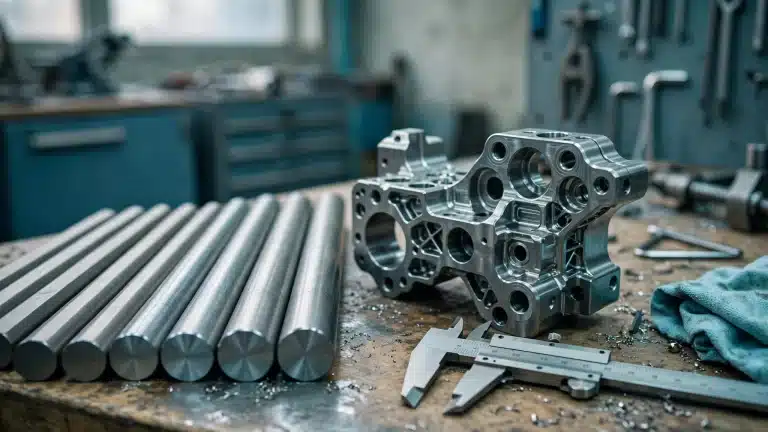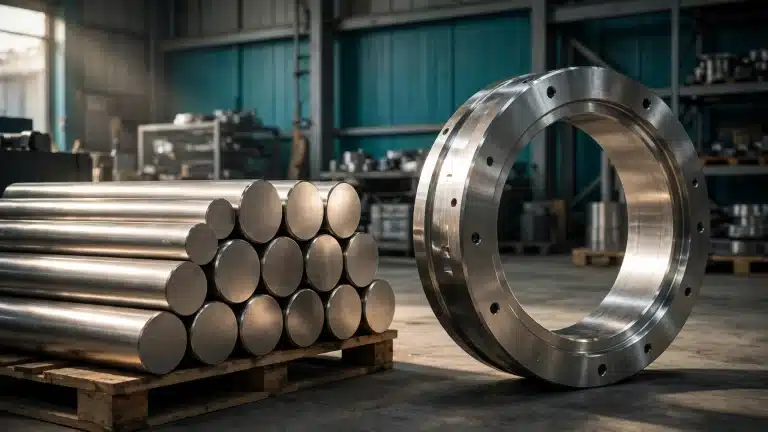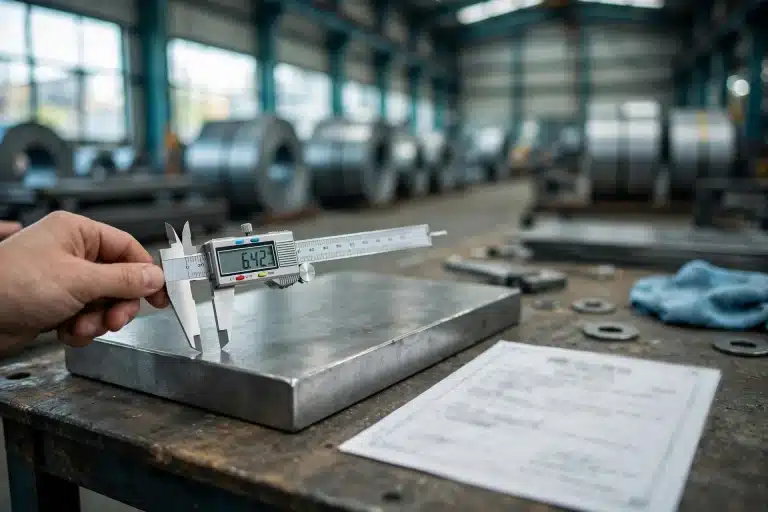
Every buyer of metal has had the same moment. You need 200 kg of something — a couple of plates, a few bars, enough to get a job out the door. The quote comes back and the per-kilo price looks like a typo. The same grade, bought by the tonne, costs a fraction of it. So you ring the supplier and ask the obvious question: are you taking me for a ride?
Usually, no. The uncomfortable truth is that a small order genuinely costs more to serve, at every step between the melt and your dock. We sell plenty of small orders, and we would rather buyers understood where the money goes than suspected it was invented. So here it is, itemised the way we would itemise it for ourselves.
Start at the mill: nothing is made in 200 kg lots
Steel mills, titanium melters, aluminium extruders — they all think in tonnes. A production lot is a heat, a rolling campaign, a billet run. Nobody fires up a line for 200 kg. Your small order therefore rides on one of three things: material from a production lot made for someone else, stock a distributor bought speculatively, or a place in a queue behind orders big enough to justify the set-up.
Each of those has a cost attached before anyone has touched a saw. The stockist who keeps odd sizes on the shelf is financing inventory that may sit for a year. That financing is in your price. It is not profiteering; it is arithmetic.
Processing: the saw does not care how many pieces follow
This is where small orders bleed the most, in our experience. Sawing, shearing, waterjet, machining — every one of them starts with set-up. A man reads the cutting list, pulls the material, sets the stops, makes a first cut and measures it. That takes the same time whether the list says 2 pieces or 200.
Spread that set-up over two pieces and it dominates the price. Spread it over two hundred and it disappears into the per-kilo rate. The cutting itself is the cheap part; it is the starting that you pay for.
There is a second, quieter cost: remnants. Cut a 180 mm blank out of a standard plate and what is left is an offcut with a shape nobody else ordered. Sometimes it goes back on the rack and eventually sells. Often it goes to scrap at a fraction of its value. On a big order, remnants average out. On a small one, somebody has to absorb them — and if the quote is honest, that somebody is in the price.
Quality and paperwork: fixed costs that refuse to shrink
A mill test certificate, a dimensional check, a PMI test on the alloy — these are per-order activities, not per-kilo ones. The paperwork for 200 kg takes the same effort as the paperwork for 20 tonnes: the same certificate retrieval, the same inspection time, the same sign-off.
This is also the corner buyers are most tempted to cut, and we will come back to that, because it is the one cut that reliably backfires.
Packing and freight: the per-kilo maths turns hostile
Export packing has minimums. A seaworthy crate, moisture protection, strapping, fumigation where required — the first kilo costs a great deal and the next ones very little. Documentation is the same: a bill of lading, a certificate of origin, customs paperwork. The fees are charged per shipment, not per kilo.
Then freight itself. Small metal orders travel LCL — less than container load — where you pay for volume and handling, and dense metal is the worst possible cargo: heavy, awkward, and charged like it is bulky. Air freight is worse; it is priced for electronics and emergency spares, and a dense pallet of steel eats the allowance instantly. What dispatchers call dead freight — paying for space or weight you did not use — haunts small shipments in a way it never does a full container.
A fixed cost spread over 200 kg instead of 20 tonnes. That one sentence explains most of the “typo” in the quote you received.
The stockist’s shelf: odd sizes are a slow business
One more honest point. Standard sizes in common grades turn over. Odd thicknesses, unusual widths, the less common grade in the less common form — these sit. Every month on the rack is rent, insurance and tied-up cash. Suppliers price slow stock accordingly, and the buyer who needs exactly that odd size, urgently, in a small quantity, is asking for the most expensive combination in the business. It is worth knowing that before the negotiation starts, because it tells you where the flexibility actually is: usually in the size, the timing, or the quantity — rarely in all three at once.
What actually brings the cost down
None of the above can be wished away. But buyers who regularly order small quantities learn to route around the fixed costs instead of fighting them:
- Consolidate into one shipment. Three small orders to three suppliers means three sets of packing, documents and freight minimums. The same material on one bill of lading pays those fixed costs once.
- Design around standard sizes. If your drawing can live with the stocked thickness instead of a size that has to be cut down from something much larger, you stop paying for remnants and extra processing. This is a conversation worth having with your engineers before the order, not after.
- Combine materials and parts in one order. Plate, bar and the custom parts machined from them, ordered together, share the set-up thinking, the inspection and the freight. Splitting them across suppliers splits none of the costs — it multiplies them.
- Plan sea freight; reserve air freight for genuine emergencies. The buyer who can wait three weeks pays a different number from the buyer who discovers the shortage on a Friday.
- Pool your demand. Group purchasing exists precisely for this problem: several buyers’ requirements for similar material are combined, so the mill or stockist sees a proper lot instead of five small ones, and the better lot price is shared across the group. The small buyer gets tonnage economics without buying tonnage.
What not to do
Two popular moves deserve a warning.
The first is stripping out inspection and certificates to shave the quote. The saving is real and small; the exposure is neither. A batch that arrives off-grade, undocumented, costs you the material, the freight, the production slot and possibly the customer. If a certificate comes with an order, verify a mill test certificate properly — it takes minutes, and it is the cheapest insurance in the whole transaction.
The second is splitting one requirement across five suppliers to win a few cents per kilo on each line. You will pay five packings, five document sets, five freight minimums, and you will manage five chances of a delay. The per-kilo price is the one number in a quote that matters least on a small order. Look at the landed total.
How we handle small orders at DILI Steel
No minimum order quantity — on materials or on non-standard custom parts — is our standing policy, and it is policy because of everything above: we would rather organise the costs away than charge them through. Group purchasing is the main tool. Orders for similar material are pooled, the mill sees a real lot, and small buyers share the lot price instead of each paying small-order economics alone. Every order, however small, gets a genuine pre-shipment inspection and its mill test certificates. If you are being quoted painful per-kilo prices for a small requirement, send us the list — sizes, grades, quantities — at [email protected], and we will tell you plainly what can be pooled, what can be standardised, and what it should cost.
FAQ
Why is the per-kilo price for 200 kg triple the tonne price?
Because most of the cost of serving an order does not scale with weight. Set-up, inspection, certificates, packing, documents and freight minimums are charged per order, per shipment, per cutting list. Spread over a tonne they are minor; spread over 200 kg they are the price. The metal itself is often the smallest part of a small order’s cost.
How does group purchasing work in practice?
Buyers with requirements for similar material have their orders combined into one larger purchase. The mill or stockist quotes for the combined lot, which earns a better price than any of the small orders would alone, and that price is shared across the group. Each buyer still receives their own material, inspected, with their own certificates — what is shared is the buying power, not the goods.
Is it cheaper to buy a full sheet and cut it myself?
Sometimes — if you already own the saw, the labour is genuinely spare, and you have a use for the remnants. Run the honest comparison: full sheet price, plus your cutting time, plus the value of the offcut you will probably scrap, against a cut-to-size quote where the supplier absorbs the remnant into their rack stock. For one-off sizes it usually favours cutting in-house; for repeated requirements, the supplier’s remnants average out and cut-to-size usually wins.