The enquiry usually arrives with the alloy already chosen. A pump shaft for seawater service, specified in Inconel 718 “because it’s the stronger one”. Or a high-load bolt set drawn in 625, on the logic that 625 is “the corrosion-proof one, so it must be the better alloy”.
Both choices are wrong in the same way: they treat 625 and 718 as two grades of the same thing, one a step up from the other. They are not. They were designed thirty years apart to solve opposite problems — one alloy built to survive chemistry, the other built to survive load. Picking between them is not a quality ranking. It is a question about what is trying to kill your part.
Two different design philosophies
Inconel 625 (UNS N06625) came out of the corrosion world. Its chemistry is built around nickel (58% minimum), chromium at 20–23% and a heavy dose of molybdenum, 8–10%, with niobium at 3.15–4.15% stiffening the matrix. It is solid-solution strengthened: the alloying elements dissolve into the nickel and make the whole structure harder to deform and much harder to attack. No heat-treatment trick is needed to get its properties — annealed 625 to ASTM B443 already delivers a tensile strength of at least 827 MPa and yield of at least 414 MPa, and it keeps those numbers without any ageing cycle.
Inconel 718 (UNS N07718) came out of the jet engine. Nickel drops to 50–55%, chromium to 17–21%, molybdenum to just 2.8–3.3% — but niobium rises to 4.75–5.5%, backed by titanium (0.65–1.15%) and aluminium (0.2–0.8%). Those additions exist for one reason: after a solution anneal and a two-step ageing cycle, they precipitate as an extremely fine, coherent phase — metallurgists call it gamma double prime — that blocks dislocation movement throughout the metal. The result, to ASTM B637 in the aged condition, is a tensile strength of at least 1,275 MPa and a yield strength of at least 1,034 MPa. That is roughly two and a half times the yield strength of 625. Nothing else in the common nickel alloy family gets close.
So the short version: 625 spends its alloy budget on corrosion resistance. 718 spends its budget on strength. Every difference below follows from that.
Side by side
| Inconel 625 (UNS N06625) | Inconel 718 (UNS N07718) | |
|---|---|---|
| Key composition | Ni ≥58%, Cr 20–23%, Mo 8–10%, Nb+Ta 3.15–4.15% | Ni 50–55%, Cr 17–21%, Mo 2.8–3.3%, Nb+Ta 4.75–5.5%, Ti, Al |
| Strengthening | Solid solution — no ageing needed | Precipitation (age) hardening |
| Tensile / yield (typical spec minimums) | 827 / 414 MPa (ASTM B443, annealed) | 1,275 / 1,034 MPa (ASTM B637, aged) |
| Useful temperature ceiling | Oxidation resistance to ~980°C; strength modest at heat | Strength holds to ~650°C, then falls off |
| Corrosion behaviour | Outstanding vs pitting, crevice attack and chloride stress-corrosion cracking | Good general resistance; clearly behind 625 in hot chlorides and seawater |
| Welding / machining | Welds readily; standard filler for dissimilar joints and overlay | Weldable but slow to machine; work-hardens, eats tooling |
| Typical uses | Marine and chemical processing hardware, bellows, seawater piping, exhaust ducting, weld overlay | Jet-engine and rocket components, high-strength bolts, downhole tools, gas-turbine hardware |
Where the environment is the enemy: corrosion
Chloride is where the gap opens up. The 8–10% molybdenum in 625, combined with high chromium, gives it exceptional resistance to pitting and crevice corrosion in seawater and process fluids, and it is essentially immune to chloride stress-corrosion cracking — the failure mode that quietly kills lesser alloys under load in warm salt water. This is why 625 shows up in seawater handling, marine hardware, chemical plants and as weld overlay on cheaper base metals that need a corrosion-proof skin.
718’s corrosion resistance is respectable — it is still a nickel alloy — but its molybdenum content is a third of 625’s, and in hot chloride service it will pit where 625 will not. Putting 718 into seawater because it is stronger is how you get a very strong part that leaks. If the part lives in seawater, sour process fluid or chloride-bearing chemicals, the conversation starts with 625.
Where the load is the enemy: strength and temperature
Run the problem the other way and 625 is the one that runs out. A yield strength of 414 MPa is fine for piping, bellows and ducting; it is not fine for a highly loaded bolt, a turbine disc or a downhole tool that has to hold enormous pressure without yielding. That is 718’s home ground, and its strength is not just a room-temperature number — the precipitates that harden it stay stable and keep working up to about 650°C, which is exactly the operating window of jet engines, gas turbines and rocket motors. No other readily weldable nickel alloy covers that combination of strength and temperature, which is why 718 accounts for such a large share of all superalloy production.
But the ceiling is real. Above roughly 650°C the hardening phase coarsens, strength drains away, and 718 becomes an ordinary alloy carrying an extraordinary price. 625, meanwhile, keeps its oxidation resistance to around 980°C — it just does so at low strength, in parts designed so that load is not the issue: ducting, bellows, exhaust systems, furnace hardware. Temperature alone does not pick the alloy. Temperature plus load does.
Fabrication reality
625 is the easier alloy to live with in the workshop. It welds readily — so readily that 625 filler is the standard choice for joining dissimilar metals and for cladding steel. Machining is slow, as with all nickel alloys, but predictable.
718 is the difficult one. It work-hardens aggressively, its strength stays high at cutting temperatures, and in the aged condition it is genuinely hard on tooling; most machining is planned around doing as much as possible in the solution-annealed state and ageing afterwards. Its weldability is actually good for a precipitation-hardened alloy — the ageing reaction is sluggish, so it resists strain-age cracking — but nobody who has machined both would call 718 the convenient option. If your part needs extensive machining after heat treatment, that cost belongs in the alloy decision, not as a surprise afterwards.
Decision rules
- The environment eats metal — seawater, chlorides, process chemicals, sour service: 625.
- The load breaks metal — high stress, fatigue, pressure, and the temperature stays under ~650°C: 718.
- Hot and lightly loaded — exhaust, ducting, expansion joints: 625, for oxidation resistance.
- Hot and heavily loaded above 650°C: neither of these is the comfortable answer, and that deserves a proper engineering conversation rather than a catalogue pick.
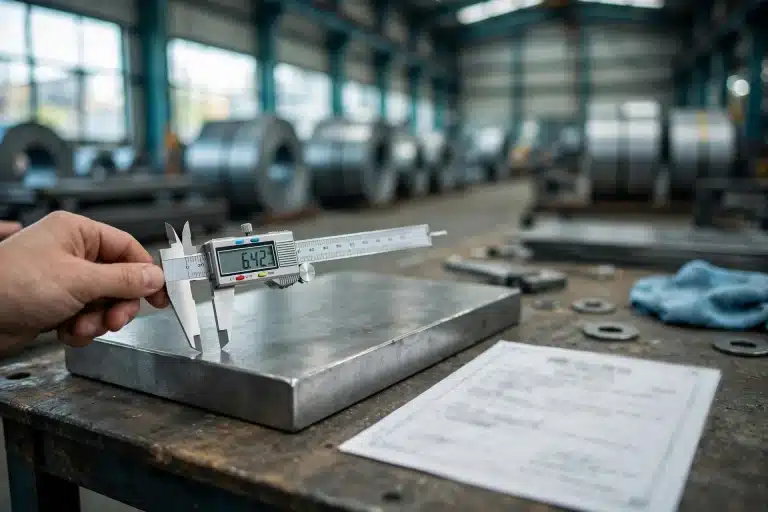
And one paperwork point that applies to both: these alloys are expensive enough that substituted or mislabelled material is a real risk in the market. Whichever you buy, check the certificate against the standard before the goods ship — our guide on how to verify a mill test certificate walks through the heat-number and chemistry checks step by step.
What we supply
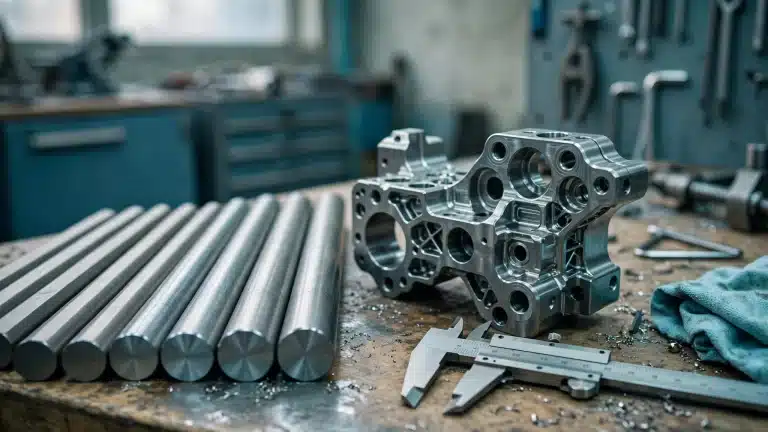
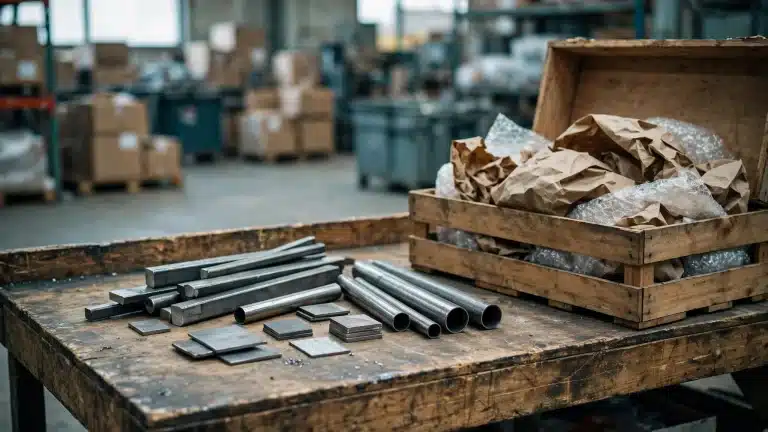
We stock and source nickel alloys including Inconel 625 and 718 in bar, plate, tube and forgings, alongside the rest of our metal materials range, and we machine alloy parts to drawing as custom parts where a finished component is needed instead of raw stock. Hard-to-find grades and small quantities are a normal part of our work — there is no minimum order quantity. Every order is inspected before dispatch, and the mill certificate is checked against the standard for the grade ordered, so the material that arrives is the material on the paperwork.
If you are between 625 and 718 on a drawing, send us the service conditions with the enquiry — temperature, medium, load. We would rather talk you out of the wrong alloy than quote it. Enquiries: [email protected].
FAQ
Can 718 replace 625 in seawater service?
Not safely as a like-for-like swap. 718 is much stronger, but its molybdenum content is about a third of 625’s, and in warm seawater or chloride process fluid it is vulnerable to pitting and crevice attack that 625 shrugs off. If a 718 part is going into seawater, that decision needs corrosion data behind it, not just a strength calculation.
Which one should I use for high-temperature bolts?
If the bolt temperature stays below about 650°C and the load is high, 718 is the standard answer — it is what most high-strength, high-temperature bolting in this class is made from. Above 650°C its hardening phase breaks down and the strength advantage disappears; at that point the bolting material choice has to be rethought around the actual temperature.
Why is 718 harder to machine than 625?
Two reasons: it work-hardens fast under the tool, and it keeps its strength at the temperatures cutting generates, so the tool is always cutting hard metal. In the aged condition the yield strength is over 1,000 MPa. Most shops machine 718 in the solution-annealed condition, then age it — plan the route before you order the material, because it affects what condition you should buy.