
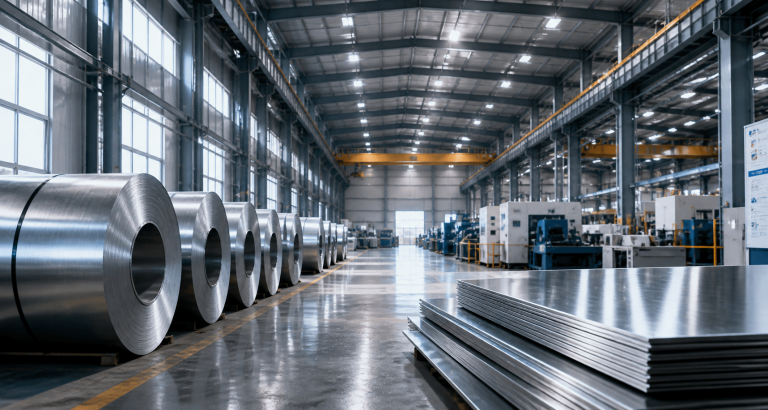
Stainless steel is an iron-based alloy that resists rust and corrosion. This resistance comes from chromium — at least 10.5% — which forms a thin, invisible oxide layer on the surface. If scratched, this layer self-repairs in the presence of oxygen.
Key Properties
- Corrosion resistance – Performs well in moist, acidic, or salty environments.
- Strength – Many grades are stronger than ordinary carbon steel, especially at elevated or cryogenic temperatures.
- Formability – Can be rolled, drawn, bent, or deep-drawn into various shapes.
- Weldability – Most austenitic grades weld easily with standard techniques.
- Appearance – Readily accepts polished, brushed, or matte finishes.
Common Grade Families
Austenitic (300 series)
Non-magnetic, excellent toughness, and very weldable.
- 304 – The most widely used. Suitable for kitchenware, tanks, piping, and architectural trim.
- 316 – Contains molybdenum for saltwater and chemical resistance. Used in marine hardware, pharmaceutical equipment, and outdoor structures.
Ferritic (400 series)
Magnetic, lower cost, but less formable than austenitic grades.
- 430 – Common in appliance panels, automotive trim, and indoor decorative applications.
Martensitic (400 series)
Magnetic, heat-treatable to high hardness.
- 410 and 420 – Used for cutlery, valves, shafts, and surgical instruments where wear resistance matters.
Precipitation-hardening
- 17-4 PH – Combines high strength with moderate corrosion resistance. Often specified for aerospace and high-stress components.
Surface Finishes
- No. 2B – Smooth, reflective finish for general industrial use.
- No. 4 – Brushed finish, common on kitchen equipment and handrails.
- BA (Bright Annealed) – Mirror-like surface for decorative or sanitary applications.
- Matte – Non-reflective, often bead-blasted or etched.
Limitations to Know
- Stainless steel is more expensive than carbon steel or aluminum.
- It has lower thermal conductivity and higher thermal expansion than plain carbon steel.
- Galling (cold welding) can occur when stainless threads are tightened without lubricant.
- In low-oxygen environments or with long-term chloride exposure, some grades can suffer pitting or crevice corrosion.
Choosing the Right Grade
For indoor, dry conditions → 304 is often sufficient.
For coastal or chemical exposure → 316 is recommended.
For high hardness and wear resistance → Consider 420 or 17-4 PH.
For magnetic response or lower cost → Look at ferritic grades like 430.
Categories
Stainless Steel Surface Finish Levels Explained
Stainless Steel Surface Finish Levels Explained Surface finish is not just about appearance. It affects corrosion resistance, cleanability, friction, and how the material interacts with