
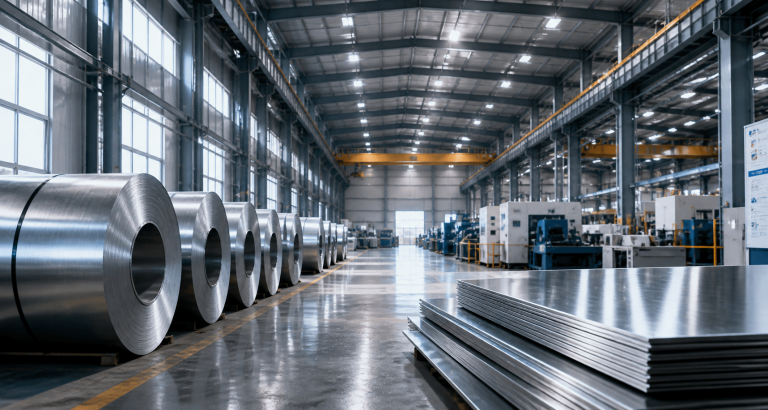
Surface finish is not just about appearance. It affects corrosion resistance, cleanability, friction, and how the material interacts with other components. For stainless steel, different applications require different finish levels — from industrial-grade matte to mirror-like reflective.
Common Stainless Steel Surface Finishes
No. 1 – Hot rolled, annealed, and pickled
- Rough, dull, and non-reflective
- Typically used for thick plates in high-temperature or high-pressure applications (boilers, pressure vessels)
- Not meant for decorative or sanitary uses
No. 2B – Cold rolled, bright heat treated, pickled, and skin passed
- Smooth, moderately reflective (not a true mirror)
- The most common finish for general industrial applications
- Ideal for tanks, piping, kitchen equipment, and automotive trim
- Accepts further polishing if needed
No. 2D – Dull cold rolled finish
- Matte appearance with very low reflectivity
- Used where glare reduction or uniform surface appearance is required
- Common in architectural panels and industrial enclosures
No. 3 – Intermediate polished finish
- Semi-reflective with visible grinding lines (typically 80–100 grit)
- Used as a base for further finishing or where moderate reflectivity is acceptable
- Often specified for some architectural and food handling equipment
No. 4 – Brushed finish
- Satin appearance with fine, uniform polish lines (typically 120–180 grit)
- Very common for kitchen equipment, handrails, restaurant surfaces, and hospital fixtures
- Hides fingerprints and minor scratches better than mirror finishes
- Easy to clean and sanitize
No. 6 – Dull satin finish
- Less reflective than No. 4, with lower grit polish (200–240 grit)
- Provides a softer, less glossy appearance
- Sometimes used for architectural panels and furniture
No. 7 – High reflective finish
- Near-mirror appearance but with some visible polishing lines
- Requires careful handling to avoid scratches
- Used for decorative columns, wall panels, and some food processing equipment
No. 8 – Mirror finish
- True mirror-like reflective surface with no visible lines
- Achieved by progressive polishing with very fine abrasives
- Most expensive among standard finishes
- Used for decorative architectural elements, elevator interiors, and high-end appliances
- Also specified for some sanitary and pharmaceutical applications where extreme cleanability is needed
Specialized Finishes
BA (Bright Annealed)
- Cold rolled and bright annealed under controlled atmosphere
- Highly reflective, similar to No. 8 but produced without mechanical polishing
- Common for thin sheets and coils in decorative or kitchen applications
Scotch-Brite / Non-directional (Grained)
- Uniform matte finish with no visible direction
- Hides scratches and wear very well
- Used for escalator panels, building cladding, and consumer goods
Pickled finish
- Chemically cleaned to remove scale and oxides after heat treatment or welding
- Matte, gray appearance
- Essential for restoring corrosion resistance after high-temperature processes
How to Choose the Right Finish
| Application | Recommended Finish |
|---|---|
| Chemical / pressure vessels | No. 1 |
| General industrial fabrication | No. 2B |
| Food processing equipment | No. 4 or No. 2B |
| Handrails and kitchen surfaces | No. 4 |
| Hospital / pharmaceutical surfaces | No. 4 or No. 8 |
| Decorative interior panels | No. 8 or BA |
| Exterior building cladding | No. 4 or pickled |
| Anti-glare or low-reflectivity needs | No. 2D or No. 6 |
Important Notes
- Cost increases with reflectivity – No. 8 mirror finish costs significantly more than No. 2B or No. 4.
- Surface finish affects corrosion resistance – Smoother finishes have fewer crevices and generally perform better in corrosive environments.
- Post-weld finishing is required – Welding destroys the original finish and oxide layer. Pickling or mechanical polishing must be done after welding to restore corrosion resistance.
- Specify by standard – Always reference ASTM A480 or EN 10088-2 when ordering to avoid confusion.
Categories
Stainless Steel: Properties, Grades, and Common Uses
Stainless Steel: Properties, Grades, and Common Uses Stainless steel is an iron-based alloy that resists rust and corrosion. This resistance