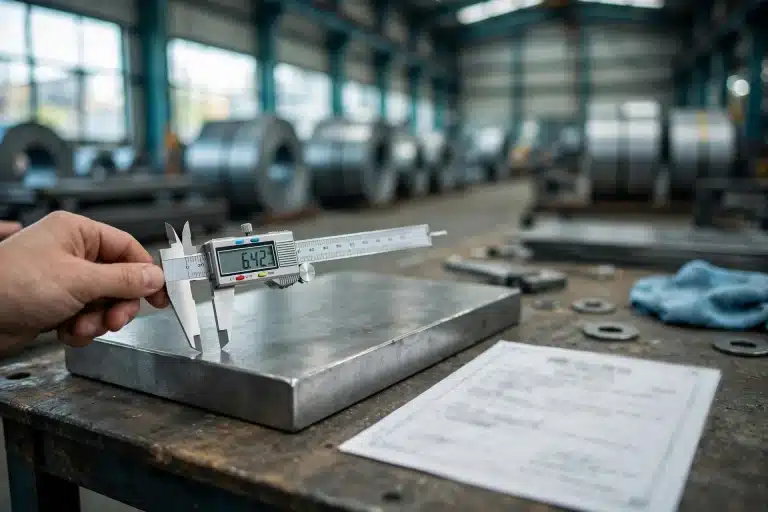
304 Stainless Steel Cold Rolled Sheet: Specifications, Finishes and Sourcing Guide
304 cold rolled stainless steel sheet is the most widely specified flat product in the 300 series. It combines good corrosion resistance, formability and weldability with a smooth, consistent surface in thin gauges. This guide covers what to specify when ordering 304 cold rolled sheet and how to avoid common quality and pricing problems.
What Is 304 Cold Rolled Sheet?
Grade 304 is an austenitic stainless steel with roughly 18-20% chromium and 8-10.5% nickel. Cold rolled means the strip is rolled at room temperature after hot rolling and annealing, which gives tighter thickness tolerances and a smoother surface than hot rolled plate. The grade is essentially non-magnetic when annealed and cannot be hardened by heat treatment.
Typical Specifications
| Item | Typical range |
|---|---|
| Grade | 304 (UNS S30400, EN 1.4301); 304L (EN 1.4307) where lower carbon is needed for welding |
| Standards | ASTM A240, EN 10088-2 |
| Thickness | Commonly about 0.3 mm to 6 mm |
| Width | Commonly 1000 mm to 1500 mm |
| Length | Cut sheets such as 2000 mm or 2438 mm, or coil |
| Finish | 2B, BA, No. 4, 2D |
| Certification | Mill test certificate (MTR) |
These are typical industry ranges. Confirm exact sizes and availability with DILI Steel before ordering. ASTM A240 sets minimum mechanical properties for 304 sheet: tensile strength of 515 MPa, yield strength of 205 MPa, elongation of 40% and a maximum hardness of 92 HRB.
Choosing a Finish
- 2B – smooth and moderately reflective; the default for general industrial fabrication.
- BA (Bright Annealed) – highly reflective, used for decorative and kitchen applications.
- No. 4 – brushed satin finish for kitchen equipment, handrails and hospital fixtures.
- 2D – dull matte finish where low glare is needed.
For a full comparison, read our guide to stainless steel surface finish levels.
Common Applications
- Food processing and kitchen equipment
- Tanks and industrial enclosures
- Architectural trim and panels
- Appliance and equipment housings
304 or 316?
304 is usually sufficient for indoor, dry and general service conditions. If the sheet will be used near the coast, in swimming pool areas or where it is exposed to chemicals, 316 is the safer choice because of its molybdenum content, although it costs more. See our stainless steel grades and properties guide for a detailed comparison.
How to Avoid Quality Problems
- Specify grade, standard, finish, thickness tolerance and surface protection film in the purchase order.
- Request the mill test certificate and check that the heat number matches the material.
- Ask for PMI (positive material identification) testing before shipment to confirm the grade.
- Inspect flatness, surface defects and edge condition before packing.
Our quality inspection service can help verify material and workmanship before goods ship.
Pricing
Prices for 304 cold rolled sheet follow nickel, mill surcharges and freight, so we quote against current market conditions rather than a fixed list price. For background, see our guide to metal price trends for buyers in 2026.
How to Order
- Send your requirement – grade, thickness, width, length or coil, finish and quantity.
- Receive a quotation – with material, processing and freight shown separately.
- Confirm and arrange shipment – including cut-to-size, protective film and export packing as needed.
Need material quickly? Check our ready-to-ship stainless steel stock, or contact DILI Steel with your specification.